

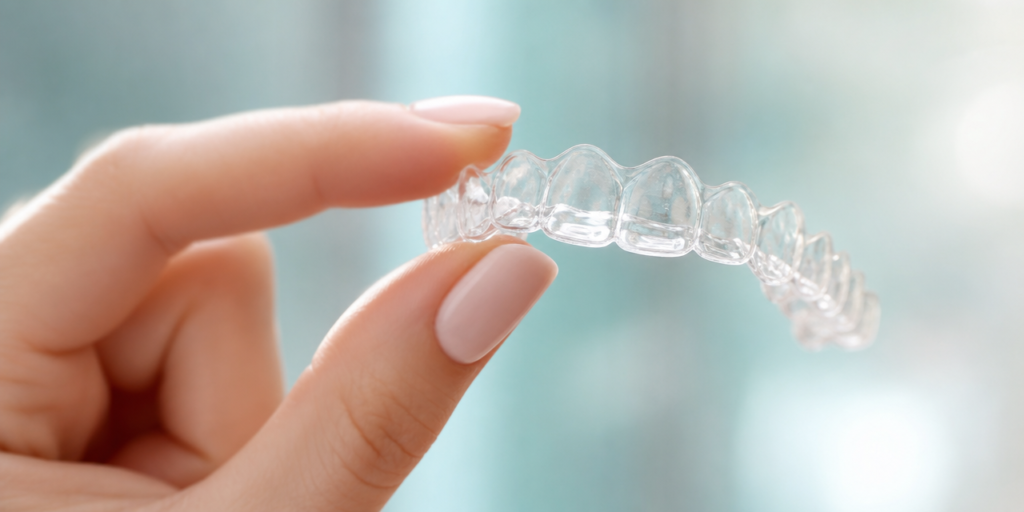
Straightening teeth used to mean brackets, wires, and years of appointments. For many people today, it means something far more comfortable, far less visible, and far more compatible with the life they’re already living. Clear aligner therapy has changed what orthodontic care looks and feels like — and when it’s the right fit for the patient in front of us, the results speak for themselves.
Clear aligners are a series of custom-made, removable trays worn over the teeth that gradually and gently guide them into a better position. Each tray is worn for a set period before moving to the next in the sequence, with each tray doing a small, precise amount of movement. The process is incremental, controlled, and — for the right candidate — highly effective.
We use SureSmile, a system we trust for the quality of its materials, the precision of its planning technology, and the comfort it offers patients throughout treatment. It’s not the most heavily marketed aligner system — but in our experience, it delivers consistently excellent results for the cases it’s designed to handle.
Clear aligners aren’t the right answer for every orthodontic situation. But for a significant number of adults and older teens, they’re an excellent one. This approach tends to work particularly well for patients who:
We assess every patient individually. If aligners aren’t the right tool for what you’re dealing with, we’ll tell you honestly and discuss what is.
Treatment begins long before the first tray is placed. The planning phase is where the outcome is really determined.
A few things worth knowing before you begin:
The trays should be worn for twenty to twenty-two hours per day. Removing them for meals and oral hygiene is one of the genuine advantages of this system — but the hours in the mouth are what create the movement. Inconsistent wear extends treatment time and can compromise the result.
Some mild discomfort — pressure, not pain — is normal for the first day or two after switching to a new tray. This is simply the teeth responding to the new position being asked of them. It settles quickly and is generally far more manageable than what patients expect.
Speech may be slightly affected in the first few days as your tongue adjusts to the trays. Most patients adapt within a short time and stop noticing them entirely.
Attachments — small tooth-colored dots bonded to certain teeth — may be used in some cases to help the trays grip and move specific teeth more precisely. They’re subtle, effective, and removed completely at the end of treatment.
We’ve evaluated a number of aligner systems over the years. SureSmile earns our confidence for a few specific reasons.
The material quality is genuinely superior — the trays are comfortable against soft tissue, resist staining well, and maintain their shape throughout the wear cycle. The digital planning platform allows for a high degree of precision in mapping tooth movement, which translates to more predictable outcomes. And the system is designed to minimize the number of refinements needed mid-treatment when the plan is well-executed from the start.
We’re not interested in the most marketed option. We’re interested in what works best for our patients — and in our hands, SureSmile consistently does.
Beyond the obvious shift in alignment, patients consistently notice:
For patients who had orthodontic work done earlier in life and watched it drift, there’s something particularly meaningful about reclaiming a result that felt lost.
The best way to find out is an evaluation. Generally speaking, clear aligners work well for mild to moderate crowding, spacing, and alignment concerns — as well as relapse cases where teeth have shifted after previous orthodontic treatment. Cases involving significant bite discrepancies, skeletal issues, or complex tooth movement may be better served by traditional orthodontics. We’ll give you an honest assessment either way.
It varies considerably depending on the complexity of what’s being corrected. Some cases are complete in as little as six months. Others take twelve to eighteen months or longer. We’ll give you a realistic estimate — not an optimistic one — based on your specific treatment plan.
For appropriate cases, yes. The key phrase is appropriate cases. Aligners are highly effective for the kinds of tooth movement they’re designed to handle. For more complex orthodontic needs, traditional braces give an orthodontist more control over specific movements. We’ll tell you which category your situation falls into.
Treatment will take longer, and the outcome may be compromised. The movement is cumulative — each tray builds on the one before it. If a tray hasn’t done its full job because it wasn’t worn enough, the next tray won’t fit or move teeth as planned. Compliance is genuinely the most important variable in how well this works.
You remove the trays to eat and drink anything other than plain water. This is one of the major practical advantages — no food restrictions, no cleaning around brackets, no dietary adjustments. Just remove, eat, brush, and replace.
Rarely. The trays are clear and form-fitted to your teeth. In normal conversation and social settings, most people don’t notice them at all. Attachments, if used, are tooth-colored and very small — also generally undetectable in day-to-day interaction.


Monday
08:00 – 18:00
Tuesday
08:00 – 18:00
Wednesday
08:00 – 18:00