TMJ Functional Protocol

Advanced, root-cause care for jaw pain, tension headaches, and clenching

Temporomandibular disorders affect far more than your jaw. Chronic tension, bite imbalance, and muscle dysfunction can cause headaches, facial soreness, disrupted sleep, and long-term damage to your teeth and joints. Our integrated TMJ protocol addresses the underlying cause — not just the symptoms — through a precise combination of neuromuscular therapy and occlusal stabilization.

What Is TMJ Therapy?

The temporomandibular joint (TMJ) connects your jaw to your skull and is one of the most complex joints in the body. When the muscles, disc, or bite mechanics surrounding it become imbalanced, the result is often pain, tension, clicking, clenching, or limited jaw movement — collectively referred to as TMD (Temporomandibular Disorder).

Our approach combines two complementary treatments: EMFACE neuromuscular therapy, which retrains and rebalances the muscles of the jaw and face, and occlusal guard therapy, which stabilizes the joint and protects against nighttime parafunction. Together, they treat both the muscle and the joint — the two systems that must work in harmony for lasting relief.

What Is TMJ Therapy?

The temporomandibular joint (TMJ) connects your jaw to your skull and is one of the most complex joints in the body. When the muscles, disc, or bite mechanics surrounding it become imbalanced, the result is often pain, tension, clicking, clenching, or limited jaw movement — collectively referred to as TMD (Temporomandibular Disorder).

Our approach combines two complementary treatments: EMFACE neuromuscular therapy, which retrains and rebalances the muscles of the jaw and face, and occlusal guard therapy, which stabilizes the joint and protects against nighttime parafunction. Together, they treat both the muscle and the joint — the two systems that must work in harmony for lasting relief.

You May Benefit From TMJ Therapy If You:

  • Experience jaw pain, soreness, or fatigue
  • Clench or grind your teeth, especially at night
  • Suffer from frequent tension headaches or facial pressure
  • Notice clicking, popping, or limited jaw opening
  • Have been told you have bruxism or bite instability
  • Experience ear pain or facial asymmetry without a clear cause
  • Are managing post-orthodontic shifting or bite changes
  • Notice worn, flattened, or chipped teeth from clenching

What Our TMJ Protocol Includes

Our integrated treatment plan is built around your specific presentation and may include:

  • Comprehensive TMJ evaluation — pain scoring, jaw movement assessment, muscle palpation, and imaging if indicated
  • Custom occlusal guard — a precision-fitted stabilization splint to decompress the joint and reduce nighttime parafunction
  • EMFACE neuromuscular therapy — a four-session series designed to retrain jaw muscles, reduce resting hypertonicity, and restore facial balance
  • Occlusal analysis — evaluation of bite interferences, wear patterns, and vertical dimension
  • Ongoing maintenance and follow-up — scheduled re-evaluation at six to eight weeks, with maintenance sessions quarterly or as needed
Every visit is unhurried, educational, and focused on your comfort.

Our Approach

We treat TMD as what it is — a multifactorial condition that requires a structured, layered response.

Our process includes:

  1. Listening first — understanding your symptoms, history, and how they affect your daily life
  2. Thorough baseline assessment — clinical evaluation and imaging where appropriate
  3. Foundational stabilization — occlusal guard delivery before any active therapy begins, to allow the joint to unload
  4. Neuromuscular retraining — EMFACE sessions delivered weekly over four weeks, adjusted to your comfort
  5. Re-evaluation and refinement — we reassess at six to eight weeks and adjust the plan based on your response
  6. Long-term maintenance — supporting your outcomes with periodic care and adjunctive options as needed

No rushed timelines. No one-size-fits-all protocols. Just precise, patient-centered care.

The Benefits of TMJ Therapy

  • Reduced jaw pain and muscle tenderness
  • Fewer tension headaches and facial pressure episodes
  • Improved resting jaw comfort and posture
  • Decreased clenching intensity and awareness
  • Better sleep quality
  • Protection of teeth and joint structures from ongoing damage
  • Improved facial symmetry where masseter asymmetry is present
  • Sustainable results with appropriate maintenance

Why Choose Our Practice for TMJ Care?

  • One of the few dental practices in the Brea and Orange County area offering the integrated EMFACE + occlusal guard protocol
  • Comprehensive evaluation before any treatment begins — no guesswork
  • Deep expertise in the relationship between bite mechanics, muscle function, and jaw health
  • Calm, unhurried appointments with genuine attention to your comfort
  • Personalized treatment plans — not packaged programs
  • Coordinated care with trusted specialists when surgical or advanced imaging is indicated

We treat the whole picture — not just where it hurts.

How the Two-Part Protocol Works

Most TMJ treatments address either the joint or the muscles — rarely both. That’s why so many patients experience only partial or temporary relief. Our protocol is built around the understanding that lasting results require treating both systems simultaneously.


EMFACE Neuromuscular Therapy
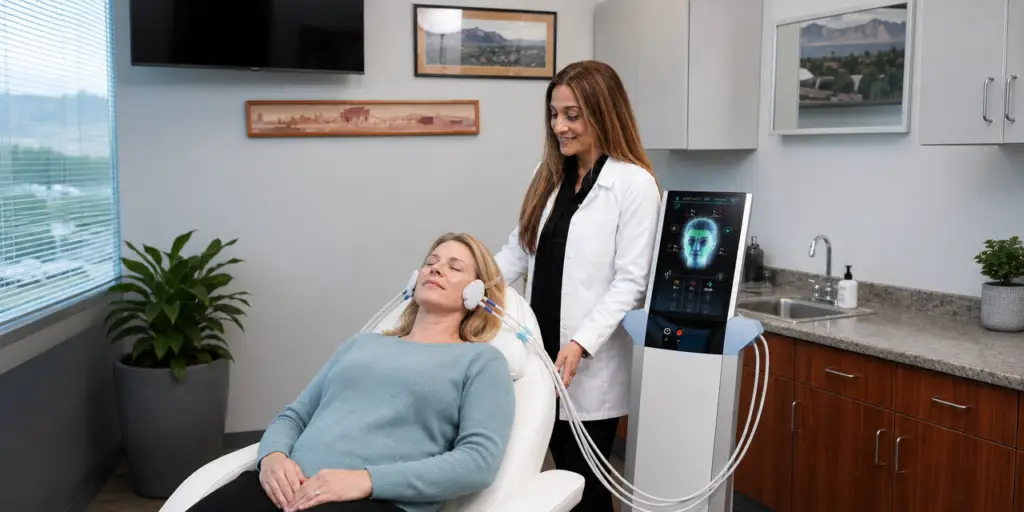
works by retraining the muscles of mastication — the masseter, temporalis, and surrounding groups — using synchronized radiofrequency and muscle stimulation. Rather than targeting hypertrophy, the goal here is balance: reducing resting hypertonicity, correcting muscle imbalances between the jaw-opening and jaw-closing groups, and restoring a healthier, more natural mandibular posture. The applicator placement is modified specifically for TMD, with emphasis on balanced bilateral stimulation across the frontalis, temporalis, and suprahyoid muscle groups.


Occlusal Guard Therapy
addresses the mechanical side. A custom-fitted stabilization splint — full-arch, flat plane — decompresses the TMJ structures, reduces the destructive forces of nighttime clenching and grinding, and stabilizes mandibular position while the neuromuscular system adapts. The guard is delivered one to two weeks before the first EMFACE session, giving the joint time to begin unloading before active therapy starts.

Neither works as well alone. EMFACE normalizes muscle behavior. The occlusal guard stabilizes joint mechanics. Together, they create the conditions for genuine, lasting recovery.

Neither works as well alone. EMFACE normalizes muscle behavior. The occlusal guard stabilizes joint mechanics. Together, they create the conditions for genuine, lasting recovery.

What to Expect During Treatment

The treatment phase spans approximately six to eight weeks from start to re-evaluation. Here is what that typically looks like:


Weeks minus two to minus one — Your custom occlusal guard is fabricated and delivered. You begin wearing it nightly for seven to eight hours to allow baseline neuromuscular unloading before therapy begins.

Week zero — Baseline measurements are recorded: pain score, maximum jaw opening, deviation patterns, muscle tenderness, joint sounds, and headache frequency. These become the reference point for tracking your progress.

Weeks one through four — One EMFACE session per week, four sessions total. Treatment intensity is calibrated to your comfort — we focus on neuromuscular balance, not maximum stimulation. You continue wearing the occlusal guard every night throughout this phase.

Weeks six to eight — Formal re-evaluation. We reassess all baseline measurements, review your symptom changes, and determine whether additional sessions or adjustments to your maintenance plan are needed.

Beyond week eight — Maintenance EMFACE sessions every three to six months, depending on symptom recurrence and lifestyle factors. Nightly occlusal guard use continues long-term.

What You Should Avoid During Treatment

To support your recovery during the active treatment phase, we recommend the following:


  • Wear your occlusal guard every night without exception
  • Avoid chewing gum
  • Avoid excessive jaw opening — including wide yawning or large bites
  • Follow a soft diet during any flare-up periods
  • Prioritize stress reduction where possible, as psychological stress is a significant driver of jaw muscle hyperactivity

These are not permanent lifestyle changes — they are protective measures during the period when your muscles and joint are adapting.

What Results to Expect and When

Clinical outcomes vary by individual, but this is what the protocol typically delivers:


By weeks four to six:

  • Reduction in muscle tenderness on palpation
  • Decreased clenching intensity and awareness
  • Improved comfort at rest — the jaw simply feels less loaded
  • More symmetrical jaw opening


By weeks eight to twelve:

  • Sustained symptom reduction that holds between sessions
  • Improved neuromuscular coordination — the jaw moves more fluidly and with less effort
  • Reduced or eliminated need for daytime splinting
  • Aesthetic softening of the masseter area in patients where muscle hypertrophy was contributing to facial fullness or asymmetry
 

Post-EMFACE, most patients also report reduced headache frequency, improved resting jaw posture, and a general decrease in the background tension they had normalized over time.

When This Protocol Is Not Appropriate

This treatment is designed for mild to moderate TMD — specifically muscle-dominant and myofascial presentations. It is not appropriate in all cases, and we will not proceed without a thorough evaluation.


This protocol is not indicated for patients with:

  • Acute inflammatory arthritis of the TMJ
  • Active disc locking with significantly limited opening
  • Severe degenerative joint disease causing pain at rest
  • Recent TMJ surgery within the past six months
  • Pacemakers or other contraindicated implanted devices
  • Pregnancy (relative contraindication per EMFACE guidelines)

If any of these apply to your situation, we will discuss alternative pathways and refer you to the appropriate specialist where needed.

Long-Term Maintenance

TMD is a condition that can recur — particularly in patients with chronic stress, postural issues, or habitual clenching. Our maintenance protocol is designed to protect your results over time rather than simply treating flare-ups as they arise.


Ongoing care typically includes:

  • Nightly occlusal guard use, continued indefinitely
  • EMFACE maintenance sessions every three to six months based on symptom patterns
  • Adjunctive support on a case-by-case basis, which may include conservative Botox for masseter hyperactivity, physical therapy, postural correction, or stress management strategies

We work with you to find the right rhythm — enough to stay ahead of symptoms, without more treatment than you actually need.

Contact Our Office

Location

255 W Central Ave, Suite 201, Brea, CA 92821

Call

(714) 990-0204

Email

info@drgailanndds.com

Hours

Monday – Friday: 8am – 6pm

Saturday: 9am – 2pm

Sunday: Closed

TMJ Functional Protocal — FAQs

Our team is here to help you feel informed, confident, and comfortable with every step of your dental care.
What is the difference between TMJ and TMD?

TMJ refers to the temporomandibular joint itself — the hinge connecting your jaw to your skull. TMD (Temporomandibular Disorder) is the clinical term for the range of conditions that affect that joint and the surrounding muscles. Most people use TMJ loosely to describe the condition, but TMD is the more precise term for what’s actually being treated.


Tension headaches that originate near the temples, around the ears, or at the base of the skull are frequently linked to jaw muscle hyperactivity or bite imbalance. If your headaches tend to be worse in the morning, accompany jaw soreness, or improve when you consciously relax your jaw, there’s a strong chance they’re TMD-related. A proper evaluation can confirm this.

EMFACE is a non-invasive neuromuscular therapy that uses synchronized radiofrequency and muscle stimulation to retrain and rebalance facial and jaw muscles. In the context of TMD, it reduces resting muscle hypertonicity, improves mandibular posture, and helps restore symmetry — addressing the muscle component of the disorder that an occlusal guard alone cannot resolve.

For most patients, nighttime wear of seven to eight hours is sufficient. Daytime use is only recommended in cases of severe daytime clenching. We’ll guide you on the appropriate schedule based on your symptoms and evaluation findings.

The core protocol involves four weekly EMFACE sessions, preceded by one to two weeks of occlusal guard adaptation. Most patients begin noticing meaningful improvement by weeks four to six. A formal re-evaluation is scheduled at six to eight weeks, after which a maintenance schedule is established.

Ongoing nightly use of the occlusal guard is recommended for most patients, as it protects the joint and dentition long-term — particularly for those with bruxism. EMFACE maintenance sessions are typically needed every three to six months depending on symptom recurrence, lifestyle factors, and stress levels.

Coverage varies significantly by plan. Occlusal guard fabrication is covered by some dental and medical insurance plans when there is a documented clinical indication. We recommend contacting your provider in advance, and our team is happy to assist with any necessary documentation.

This protocol is designed for mild to moderate TMD — including myofascial pain, bruxism, and muscle-dominant presentations. It is not appropriate for acute disc locking, severe degenerative joint disease, or recent TMJ surgery. If your case requires specialist evaluation, we will coordinate a referral to an appropriate oral and maxillofacial specialist.


Our Services

Restorative Dentistry

Carefully planned treatments that restore strength, function, and comfort while preserving your natural teeth whenever possible.

Cosmetic Dentistry

Refined cosmetic treatments designed to enhance your smile while maintaining a natural, balanced appearance that feels like you.

Kids Dentistry

A gentle, patient-centered approach designed to help children feel safe, relaxed, and confident.
BOOK a visit

Come visit us and experience compassionate care

Whether it’s your first visit or you’re a returning patient, our team is here to provide you with personalized
care in a relaxed and friendly environment.
Fill out the form below, and we’ll get back to you as soon as possible.

Follow Our Smile Moments on Instagram

Stay connected with us through real patient transformations, behind-the-scenes moments, tips for a healthier smile, and updates from our warm, family-friendly practice.
 We love sharing the little moments that make great dentistry feel personal.

Book Your Appointment Today

We’re here to make your visit comfortable from the very first step.
Fill out your details below, and our team will call or email you back as soon as possible — whichever you prefer.
Our Office Hours

Monday

08:00 – 18:00

Tuesday

08:00 – 18:00

Wednesday

08:00 – 18:00